The product owner and the development lead wanted the same transaction flow with more fields bolted onto it. That flow was built around the backend database structure, not around the person filling it in, so it carried no hierarchy and no visible field dependencies. The user absorbing that ambiguity was a cashier or a support rep managing high transaction volume during a live customer interaction, not a power user with time to spare. Payment technology was already under pressure from the pandemic-driven shift to omnichannel transactions, and at a platform scale touching over 130 million merchants globally, every ambiguous field carried the price of a lost transaction.

ROLE
Design Lead, transaction settlement workflow and enterprise design system governance
TIMELINE
Payment Module Engagement: 3 months. Design System Engagement: 2 years
TEAM
7 UX designers, 3 platform developers, 1 accessibility coach, 1 product owner
STAKEHOLDERS
Product pods across domains, platform design system leadership, transaction module product and development leads
TOOLS / SYSTEMS
Enterprise component library and design system framework built on a global payments platform’s design standards (React, Angular, Flutter)
CONSTRAINTS
WCAG 2.1 compliance requirement, multi-channel scale across desktop and mobile, federated team structure with no single point of ownership over components
Designed for the System, Not the Person Running It
Two separate fights on this engagement turned out to be the same fight. One was about a form. The other was about who gets to own a design system. Underneath both was the same habit of building for the convenience of the system that already existed instead of the person forced to operate inside it.
The Flow That Made the Cashier Do the Math
I didn’t argue the point directly. I built a prototype and had the product owner and development lead run through it themselves, timed. Once they saw how long the ambiguity actually cost, and how much of that time was spent guessing which fields depended on which, the direction changed.
The fix wasn’t more fields. It was grouping dependent fields together, so entering one made its downstream requirements visible instead of discoverable only on submission failure. I also reordered the flow to match the actual sequence of questions a cashier asks a customer during a transaction, not the sequence the database happened to store them in. Neither change cost additional development effort. The product owner got a faster flow, the users got a legible one, and the updated field groupings were structured cleanly enough that the design system absorbed them without a special case.

No One’s Job, Everyone’s System
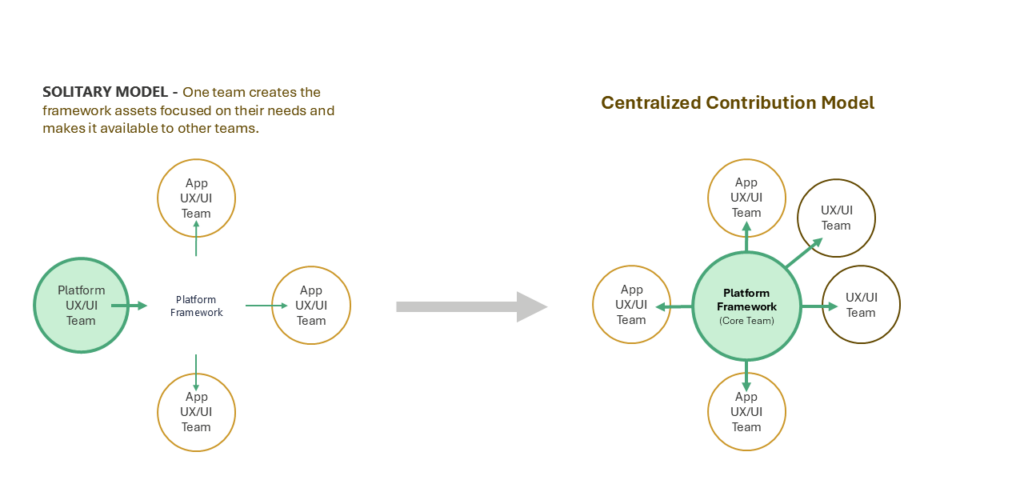
The organization had already tried, and abandoned, one failure mode before I arrived, and was living inside a second one. I recognized both patterns against a published design-systems team-scaling framework rather than naming them from scratch, which is what let me diagnose the failure mode quickly instead of relearning it by trial and error over another six months. Originally, teams built in isolation, a solitary model where each product team maintained its own version of shared components with no coordination at all. That gave way to a centralized model where one team owned all contributions, and any product pod could commit new components and patterns directly as they shipped features. Centralization was the status quo I inherited, and it was already failing for a different reason than solitary work had. Quality varied by pod. Redundant patterns accumulated because no one was checking for overlap. The products consuming the system ended up with disjointed experiences module to module, despite there being, on paper, an owner.
My first instinct was to shrink the problem, not restructure it. I proposed keeping a centralized team but making it smaller, with a simpler intake process attached, effectively a tighter version of the same model the organization had already tried once before under a different name. Working through it across individual and small-group conversations, I reversed that position. The council structure and the decision tree itself were mine to design, since the source material named the failure patterns but didn’t prescribe a fix. A federated model with a decision tree for commits was the better fit, not because it centralized quality control tighter, but because it distributed accountability. Any pod building something new had to run it through the decision tree to confirm they were using existing components correctly or had actually built something novel worth contributing back. Governance stopped being one team’s job, which meant it also stopped being one team’s bottleneck, and stopped being no one’s job the way the solitary model had left it before that.

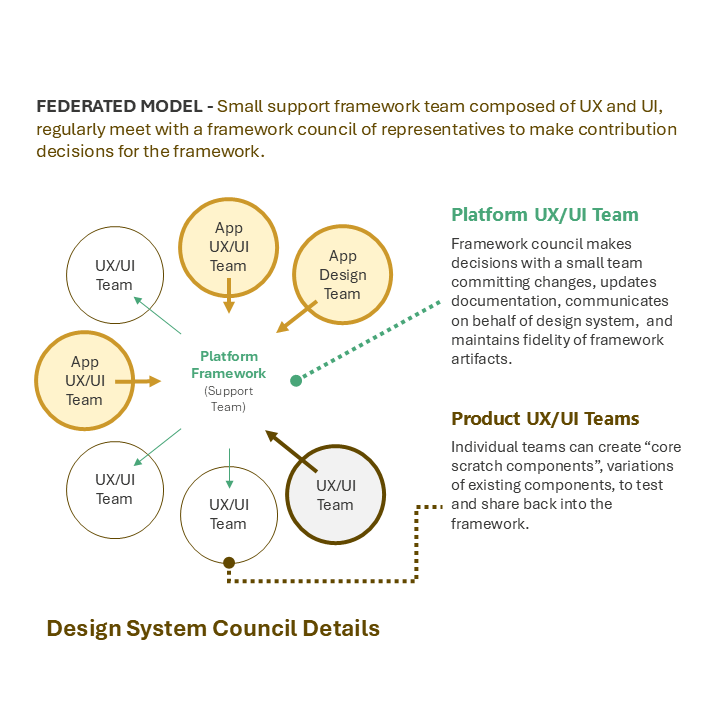
- Supports multiple teams providing experience improvements to the framework
- Office hour meetings can promote collaboration with additional teams to support their efforts for onboarding to the framework and foster contribution
- Support team can hold residency positions for other teams to cycle team members through to understand maintenance process and core scratch component creation techniques
Three models, in order: solitary, where nothing was shared; centralized, where one team owned everything and became the bottleneck; federated, where accountability distributed across every contributing team.
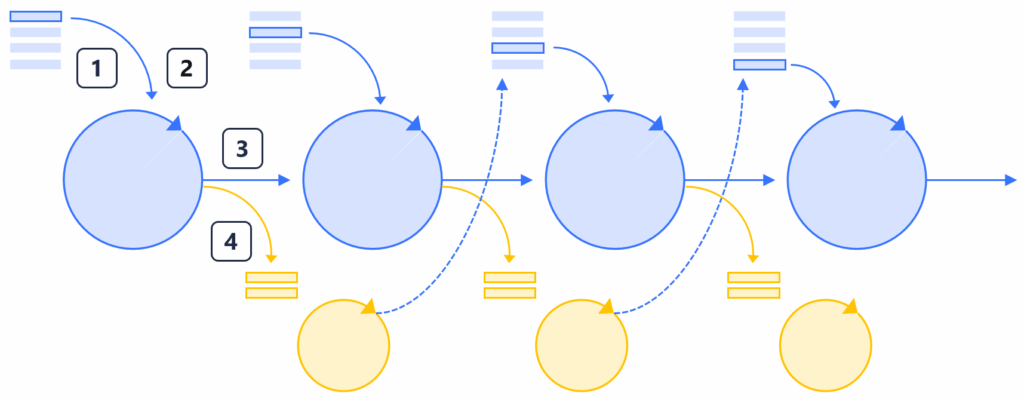
Domain/Initiative Track ( blue)
“Business as Usual work” is independently prioritized and road-mapped by domains. New component requests branch off from the regular track, domains would need to use an interim solution for their next release.
Components Track ( yellow)
Needs for new or enhancements components identified in the Domain Track would be worked on in a parallel track. Domains would use the Intake Process to start this conversation. Approved and packaged components would be ready for domains to prioritize in their next release.
Where This Fits the Broader Pattern
Design systems fail in predictable stages as organizations scale past a certain number of contributing teams. Solitary ownership breaks down first, every team maintaining its own components with no coordination. What follows is usually an over-centralized team that becomes its own bottleneck, the exact failure this platform was living inside before the federated model replaced it. That’s the field this engagement sat in, not a claim about what this specific rebuild proved on its own.
Model concepts inspired from source: https://medium.com/eightshapes-llc/team-models-for-scaling-a-design-system-2cf9d03be6a0
- Grouping dependent transaction fields and re-sequencing the flow to match real cashier questioning eliminated the guesswork that was driving submission errors, at no added development cost.
- The federated governance model, with its decision tree and four review mechanisms, ended the pattern of redundant pod-built components accumulating unchecked under the prior centralized model, and it exists as a built process rather than a recommendation.
- The component and flow decisions throughout this engagement were grounded in named merchant personas spanning micro to mid-market segments, each built from direct research quotes and real payment-volume ranges, not assumed user archetypes.
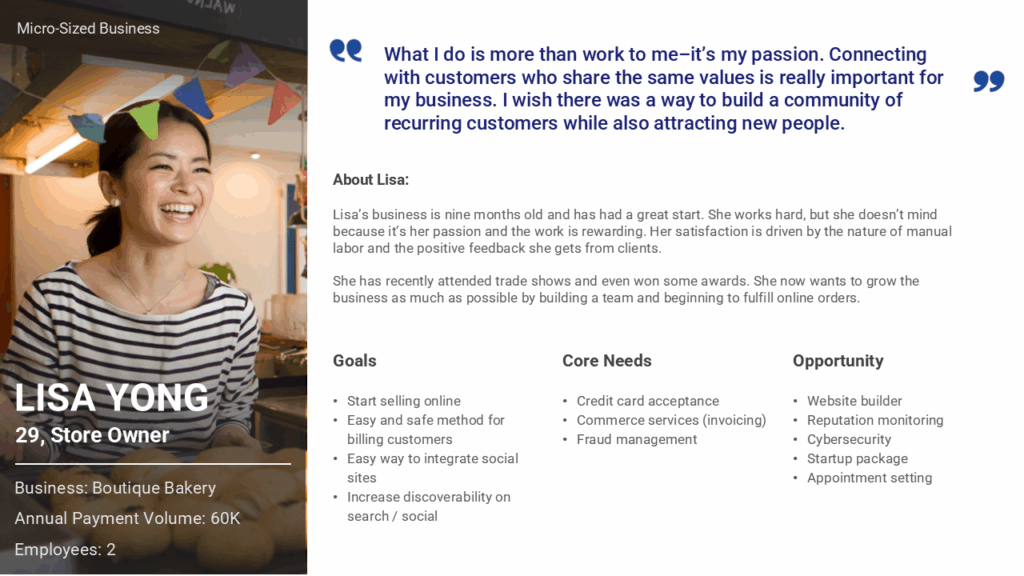
Persona depiction of a micro-sized business. This persona set the baseline for payment workflows with the least data to capture.
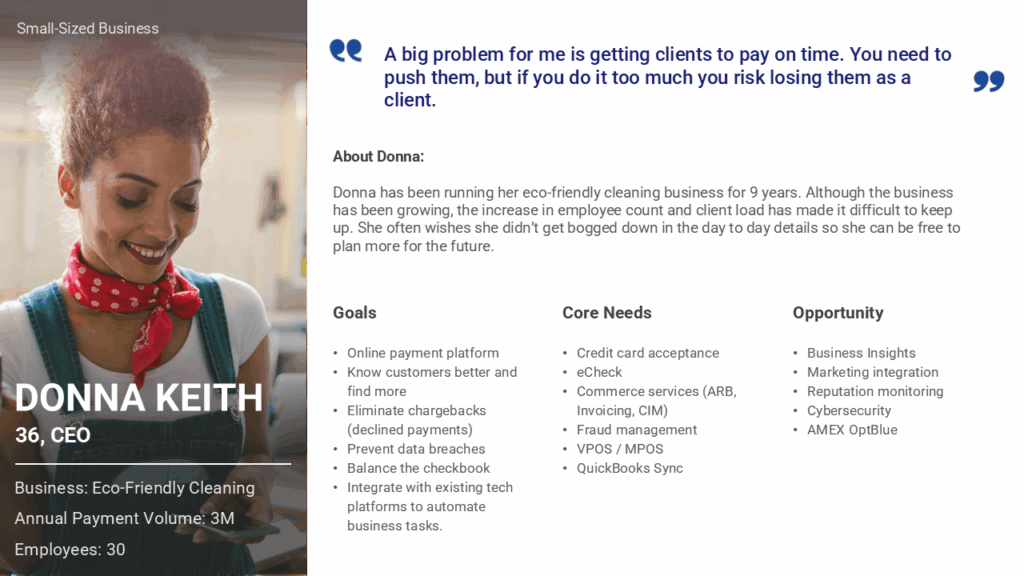
Persona depiction of a small-sized business. This persona set the baseline for payment workflows that only captured payments online.
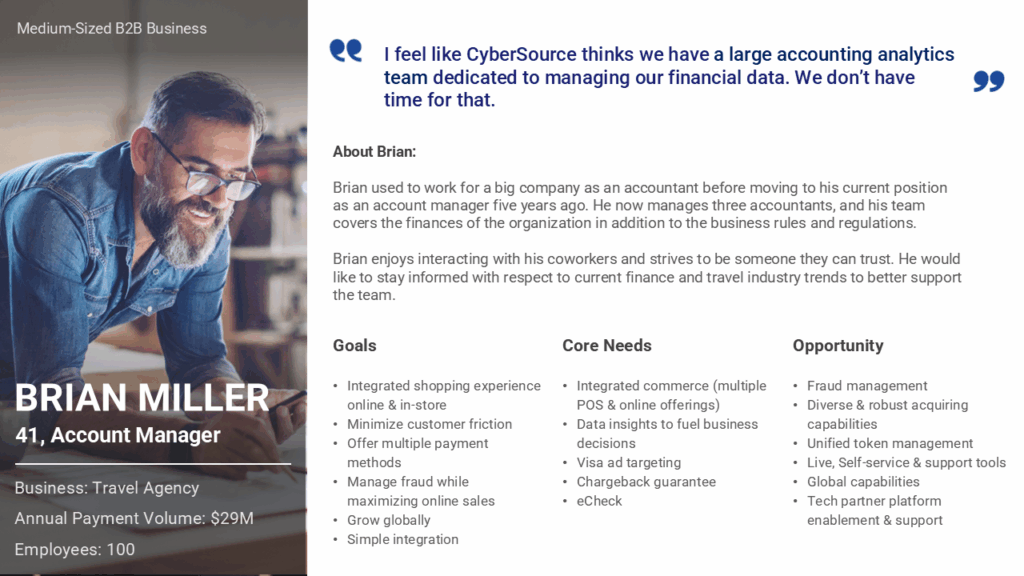
Persona depiction of a medium-sized B2B business. This persona set the baseline for payment workflows that represented the medium to large sized business that only captured payments in 2 channels.
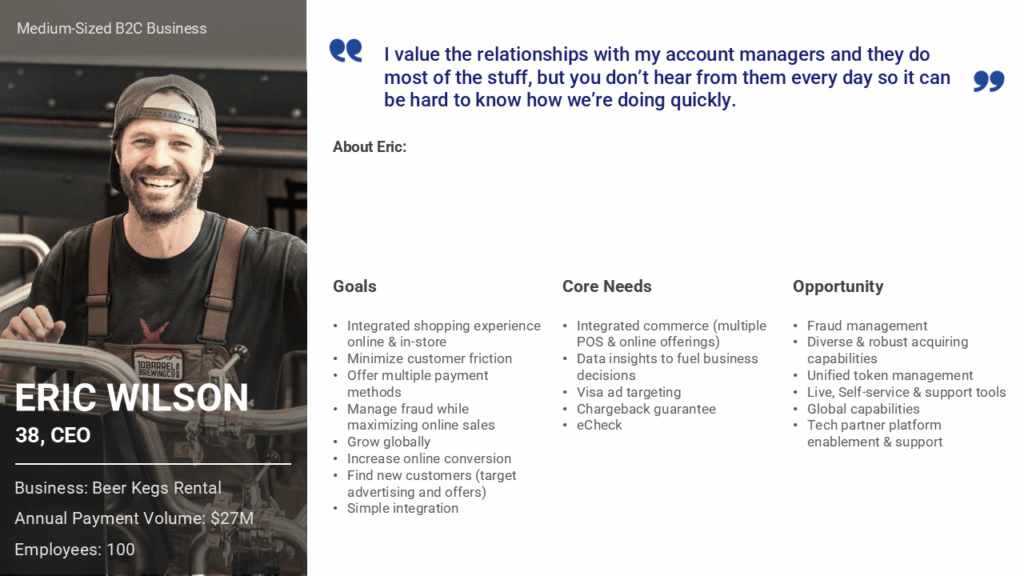
Persona depiction of a medium-sized B2C business. This persona set the baseline for payment workflows that represented the smaller large companies and enterprise sized business that only captured payments in multiple channels.
What I Can Point To
What I can point to is the artifact itself. The governance model, the decision tree, and the persona set are real, built things rather than retrospective claims about impact I can no longer verify.
The Question I Ask First Now
The correction here wasn’t proposing governance. It was recognizing that centralization and quality aren’t the same lever. My first draft of the fix just made the bottleneck smaller, a tighter version of a model the organization had already tried and moved past once. The version that worked distributed the decision, not the workload, which is a different design problem entirely.
That test now shapes how I evaluate any process I’m asked to fix. Before proposing a structure, I check whether the failure is a capacity problem or an ownership problem, because a smaller centralized team solves the first and makes the second worse. The transaction flow work taught the adjacent lesson: the cost of ambiguity is invisible to the person who designed the system and fully visible to the person forced to operate inside it. Timing that gap, rather than arguing it, is still the tool I reach for first when a stakeholder is confident their flow is fine.
Interested in how federated governance can scale a design system without one team becoming the bottleneck?
Continue Exploring

Bringing the Grid to the Table
A missed disconnection notice isn’t a UX gap. It’s a customer finding out the power’s off when the lights don’t come on.

The Loop Healthcare Forgot to Build
Patient and provider needs don’t stay mapped. They keep moving the moment the experience actually improves.